AI is creating new work. Who gets to grow into it?
New AI-linked roles are appearing. The opportunity for a smaller business is to help the people who already know its work grow into what comes next.
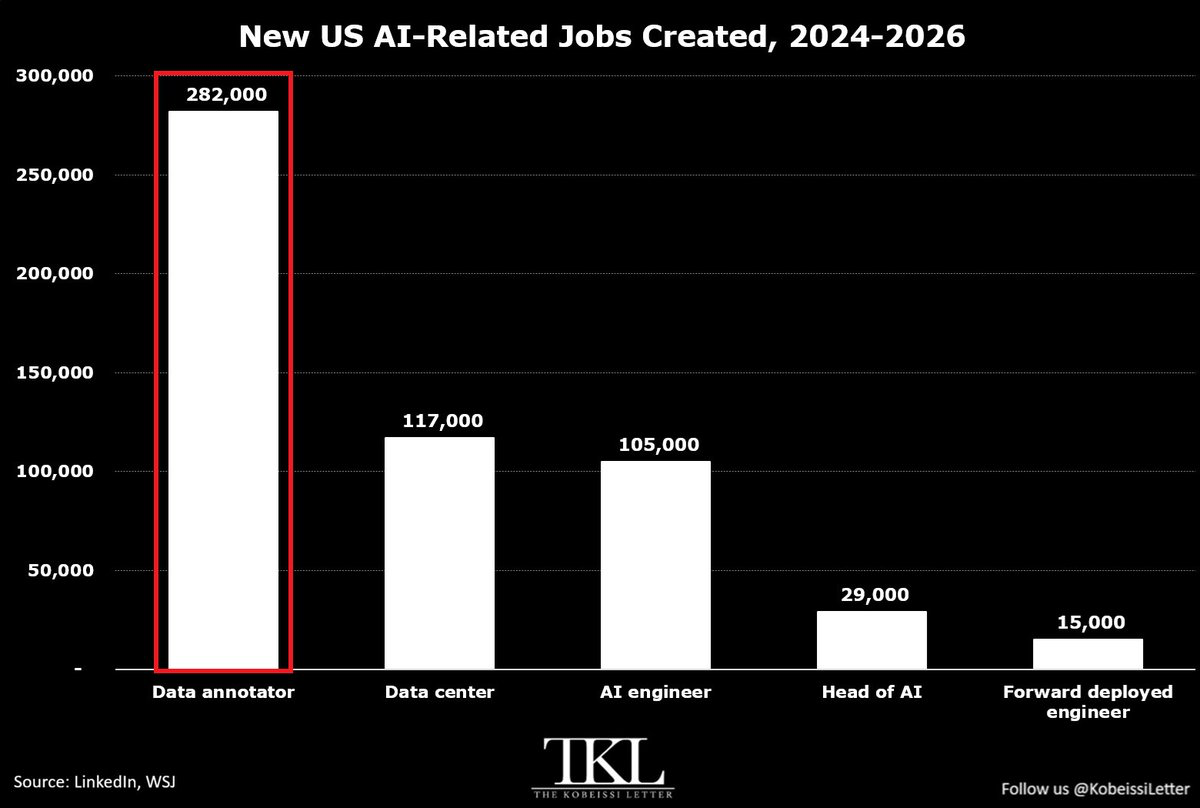
A number in The Kobeissi Letter's post on AI jobs stuck out to me: it says more than 750,000 AI-linked jobs have appeared in the US since 2023, citing LinkedIn estimates. The accompanying chart shows selected roles, including data annotators, data center workers, and AI engineers; those bars are not the full 750,000. We hear so much about the jobs AI may take away that it is easy to miss the work being built around the technology. LinkedIn's published labor-market report separately counts at least 1.3 million AI-related job opportunities globally over the prior two years. Neither figure measures AI's net effect on employment, but both show new kinds of work appearing.
The part I keep coming back to is who gets to do that work. LinkedIn's report says US job postings requiring AI literacy grew 70% year over year. That does not mean every company needs to hire an AI engineer, or that every employee needs to become one. For a team of 10 to 100 people, the need may look more familiar: a finance employee who can check a model's analysis against the source numbers, an operations manager who can redesign a repeated handoff, or a customer-facing employee who knows when an AI-assisted answer needs a person. Those skills grow out of knowing the business well, then learning what the technology can and cannot do.
I think that is where smaller companies have an advantage they may not recognize. The people already on the team know where the questions repeat, where a process breaks, and what a customer actually expects. If they are given time to experiment with approved tools and a chance to shape a better process, they can move into some of this new work without waiting for a new job title to appear. A company still may need outside technical help, but its employees should not be spectators while someone else decides how their work changes.
There is a real difference between an AI-linked job appearing somewhere in the economy and an employee having a path into it. An International Labour Organization review of the evidence finds that large-scale displacement has so far been limited, while warning that benefits and risks are uneven and that opportunities for younger workers may erode. A rising count of new roles cannot tell us whether a particular employee has the training, support, or opportunity to take part. Companies have to make those paths visible.
At Ruby, we start by getting to know the people doing the work and mapping how it actually moves through the business. Once we understand the recurring tasks, the information employees use, and the decisions they own, we can work alongside them on the places AI could help. The training then has a job to do: help a person feel comfortable testing the tool, checking its work, and improving the process around it. As the platforms change, we bring relevant updates back into those workflows so the team's skills keep growing with the technology.
The estimate caught my attention because it challenges the idea that AI only removes work. What matters to me now is whether the people already doing valuable work get a chance to shape what comes next. New roles will keep appearing. A good starting point for a company is to ask which new capabilities its current employees could build into the work they know best.
Sources & further reading
Start with the work. Build the right system around it.
We help teams understand where AI is useful, choose the right tools for the job, and build the confidence to keep improving.
Book a Call