AI is moving faster than our ability to understand it.
Stanford's 2026 AI Index shows how far the technology has come, but also how much work remains in preparing people to use it well.
The 2026 AI Index from Stanford paints an interesting picture of where we are with artificial intelligence. In 2025, AI systems made huge strides in their ability to reason, write software and complete tasks on a computer, while organizations around the world continued to adopt the technology. At the same time, people became increasingly nervous about what this progress would mean for their jobs and the way they live. Both things can be true, and understanding the relationship between them is going to be increasingly important for companies introducing AI into their workforce.
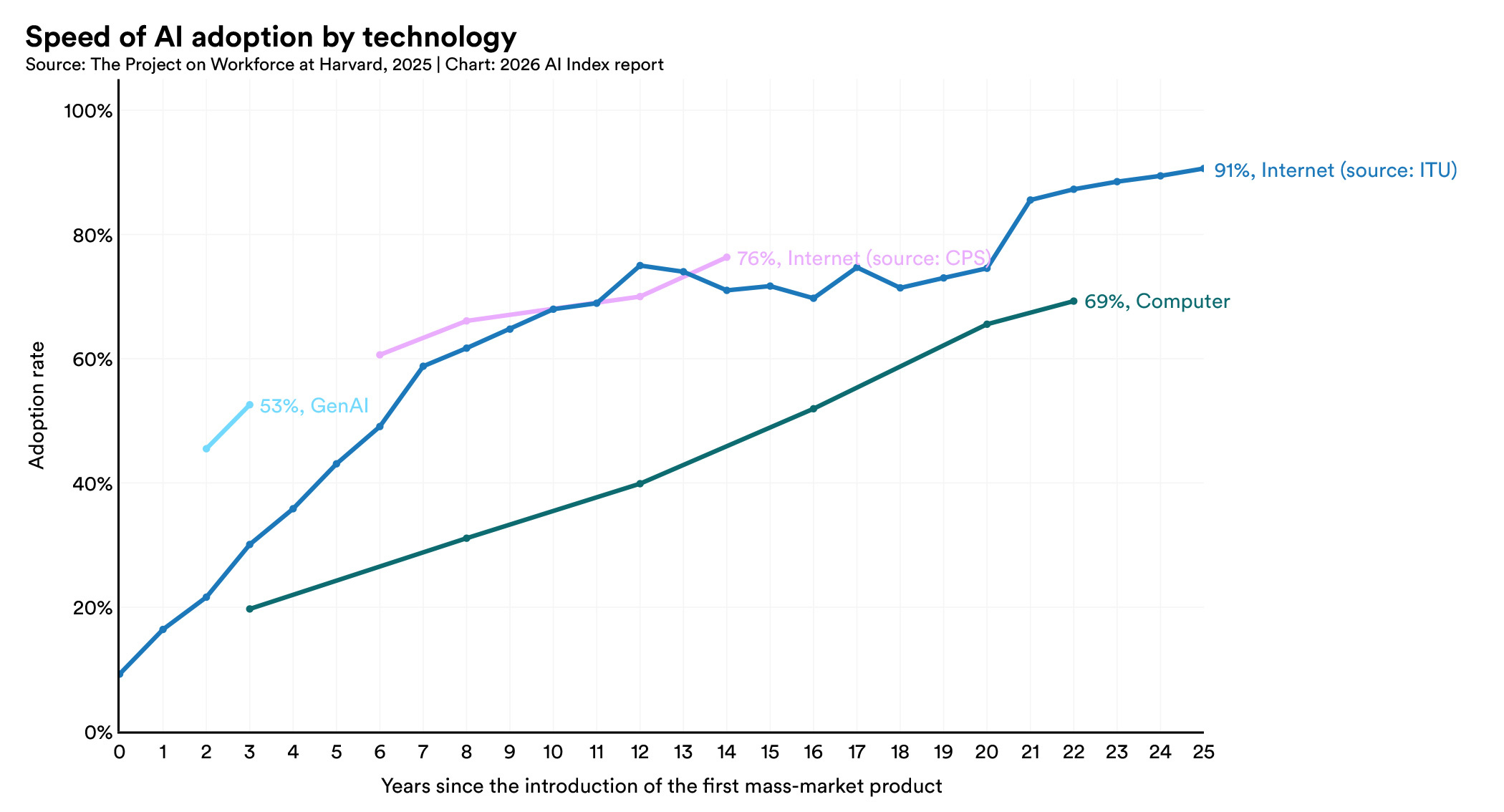
One of the numbers that deserves attention is in the report's economy chapter. The percentage of surveyed organizations using AI increased to 88% in 2025, yet the use of AI agents remained in the single digits across nearly all business functions. There is a considerable difference between giving an employee access to an AI tool and having a reliable process where that tool helps them complete their work. A company can have a subscription for everyone and still have employees spending hours collecting information for a report that looks the same every week.
The research on productivity helps explain where companies might start. Stanford highlights studies finding improvements of 14% to 15% in customer support, 26% in software development and 50% in marketing output. These came from different studies and environments, so we cannot assume that introducing AI into your own company produces those same results. What they do illustrate is the value of identifying structured work, understanding what a good result looks like and giving employees a way to check it. More complicated work presents a different set of challenges, particularly when the person doing it needs to develop judgment over time.
What happens to the people doing the work?
The public opinion chapter is just as important as the technology chapter. In 2025, 59% of respondents globally felt that AI products and services offered more benefits than drawbacks, while 52% reported feeling nervous about them. Stanford also reports that nearly two-thirds of Americans expect AI to lead to fewer jobs over the next 20 years. It makes sense why an employee might be hesitant to embrace this technology if the only conversation they hear is about making the business more efficient.
Imagine an employee who spends several hours every week pulling information together for a client update. If we help that person use AI to prepare the first draft, what happens to the time that is saved? They could spend more time understanding what is happening with that client, have a more meaningful conversation with them or catch an issue that otherwise would have gone unnoticed. But if they are simply handed more reports to produce, it becomes harder for them to see what they gained from the change.
This is also important for younger employees entering the workforce. The Index points to uneven employment trends, including declines among younger software developers, without establishing that AI alone caused those changes. The tasks companies automate today are sometimes the same tasks through which junior employees used to learn. A business needs to think through how people will continue developing the expertise to review AI-generated work and eventually make decisions of their own. AI opens the door to new ways of teaching those skills, provided we make the time for people to learn them.
At Ruby, we start by getting to know the people doing the work. Once we understand what takes up their time and what they would like to be able to do more of, we can build workflows and training around those processes. We want the people using AI to understand how an answer was produced, where to check the information and when their own expertise becomes important. We also want companies to look at productivity in terms of the time and capacity people gain, rather than treating every hour saved as an immediate cost reduction.
There is a tremendous amount to be excited about in Stanford's report. More capable and accessible technology gives smaller companies opportunities that may have been out of reach only a few years ago. The question moving forward is what we do with that opportunity. If we can make the experience of learning and using AI as much of a priority as the technology itself, we can build companies where people have more room to grow alongside it.
Sources & further reading

Where could AI give your team time back?
Tell us about the work that takes up your team's time. We'll talk through where AI could make a real difference and what it would take to get there.