When AI can do the accounting task, what changes for the accountant?
A study of defined accounting tasks suggests that the valuable human work may move toward review, judgment, and the people depending on the result.
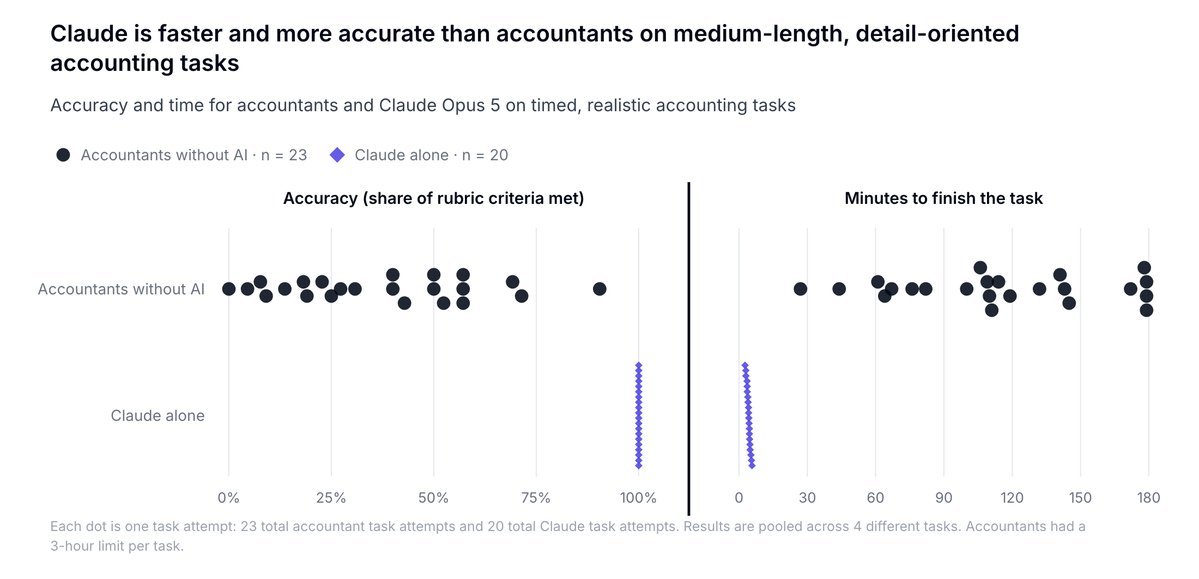
I had to read this study from Mercor twice. The researchers gave 12 licensed CPAs four different month-end close scenarios built from simulated company files. Across 23 attempts completed without AI, the accountants spent much of their allotted time searching the files, working through the company's rules, and calculating the answer. Mercor then ran Claude Opus 5 through those same four tasks 20 times. In its evaluation, the model met every scoring criterion on every run and finished each one in under ten minutes.
That result deserves attention, especially because these were recognizable accounting problems: finding the right figures, catching something coded to the wrong account, and putting the result into a table. The human attempts mostly took somewhere between 30 minutes and the three-hour limit, and the study's chart shows a wide spread in their scores. The model was much faster on this particular set of well-defined tasks, and its submitted answers received perfect rubric scores across the 20 runs.
There is a difference between that finding and saying that AI can now do an accountant's job. Mercor selected four tasks, simplified them for the study, and gave participants a map of the files. The accountants had no coworkers to consult and none of the accumulated company context they would normally bring to a close. Their answers were graded against detailed rubrics, with an AI judge whose grades were checked against eight human-graded submissions. Mercor itself says the setup favored skills models are unusually good at: searching lots of files, following detailed instructions, and catching small exceptions. Client conversations, deciding which questions to ask, and handling unclear information were outside the test.
Still, I don't think those limits make the result easy to dismiss. They help us see where the boundary is moving. When a task has the necessary data available, a clear goal, and an answer that can be checked, a capable model may already do a meaningful part of the work faster than a person can. The question for a business becomes what happens before and after that calculation. Who knows whether the files are complete? Who resolves the discrepancy the model cannot see? Who signs off on an answer that affects a customer or a financial statement? And what could that person do with the time they used to spend reconstructing the numbers?
For an accounting team, the center of the job may shift from preparing every figure by hand to shaping the process, testing unusual cases, reviewing the evidence, and explaining what the result means to a client. More of the day could be spent talking with people, understanding what they need, and making a judgment that depends on relationships and context. That is not a small part of the job left over after automation. It is the part where a professional can bring more of their expertise and attention when tedious preparation takes less of their time.
Ruby's role is to help teams make that shift with the people who do the work today. We map the steps with employees, identify where the information is verifiable and where judgment or a client conversation is needed, then build a workflow they can test inside their approved tools. Hands-on training helps the team learn how to review the output rather than simply accept it. The point is to give people time and energy back for the work they are capable of doing best, while making sure a person still understands and owns the result. As models improve, we return to those workflows and update the parts that can now be done differently.
The study does not mean every company can automate its close tomorrow. It does signal that the purpose of some roles is changing. If a defined part of the work can be completed in minutes, a company has to redesign the process around it so people can spend more time reviewing, asking better questions, and working with the customers and colleagues who depend on them. I think that redesign has to start with the people doing the job, because they know both the work the model can see and the work it cannot.
Sources & further reading
Start with the work. Build the right system around it.
We help teams understand where AI is useful, choose the right tools for the job, and build the confidence to keep improving.
Book a Call