You are not behind on AI.
The public conversation can make AI adoption feel further along than it is. There is still time to learn with your team and build useful habits.
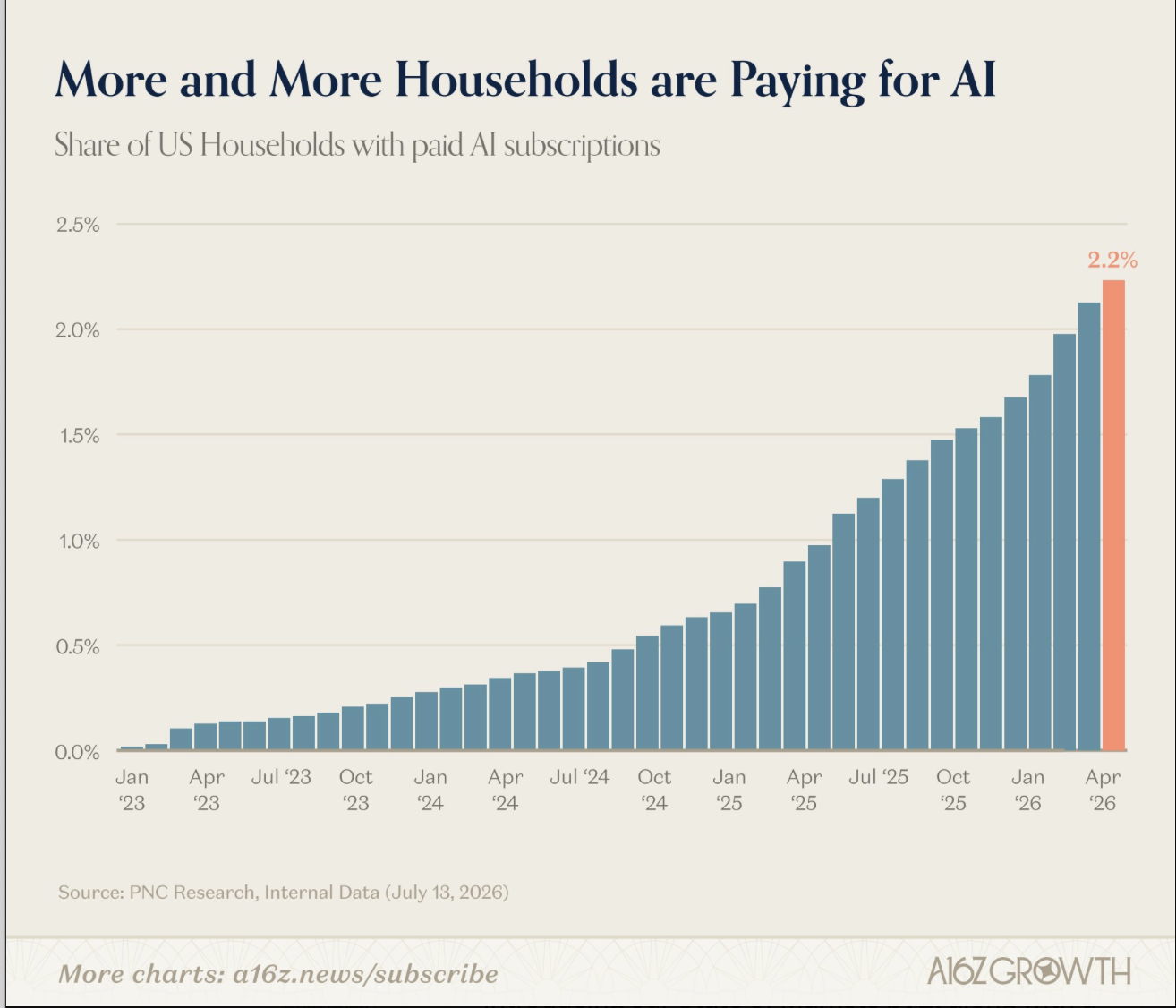
It is easy to feel behind on AI right now. Every week brings another model, another feature, and another story about a company that seems to have changed overnight. If your team is still figuring out where to start, all that noise can make it feel like everyone else has already moved on. That is why a number in a16z's State of Markets report caught my attention: its chart puts the share of US households paying for an AI service at 2.2% in April 2026. That is a measure of paid household subscriptions, not of everyone who has tried or benefited from AI, and a16z says the figure has since grown. But it is a useful reminder that this change is still in its early stages.
I don't read 2.2% as proof that only 2.2% of people use AI or that the technology has failed to find a place in their lives. Many tools are free, bundled into software people already use, or paid for by an employer. What it tells me is how far we still are from AI becoming something most people have deliberately made part of their routine. The public conversation moves faster than day-to-day adoption, and it can make a normal learning curve feel like a crisis.
The household figure does not measure business adoption, but I recognize the same feeling when I talk with companies. Leaders worry that they missed the moment to act because their employees are not already building advanced workflows. Some team members have tried a prompt or two, while others are doing impressive work in the same account. Most are still learning when the tool is useful, which company information is approved for it, and how to check an answer before relying on it. That is a reasonable place to be at this stage.
For a business with 10 to 100 employees, the opportunity is to learn with intention while there is still room to shape how the work changes. Start with a question an employee answers repeatedly, a report they rebuild every Friday, or the notes from a call that need to become a reliable next step. Find the source information, agree on what a useful result looks like, and let the person doing the work test it. The goal is for an employee to understand why they would return to the tool tomorrow, and to feel confident about reviewing what it gives them.
At Ruby, we tell teams that they are not behind. We spend time with the people doing the work before deciding what to teach, because their questions and processes tell us where AI can actually help. Then we build hands-on training around those tasks and help employees turn a promising first use into a process they can return to. As platforms change, our ongoing support brings the relevant updates back into that work so employees do not have to track every announcement themselves.
The 2.2% figure cannot tell a company how much to spend, or predict how quickly its people will adopt AI. It does help put the moment in perspective. We are early enough that a team can take the time to understand its work, bring employees along, and build good habits before those habits become harder to change. You do not need to have everything figured out today. You need a useful place to begin and people who feel capable of taking the next step.
Sources & further reading
Start with the work. Build the right system around it.
We help teams understand where AI is useful, choose the right tools for the job, and build the confidence to keep improving.
Book a Call